
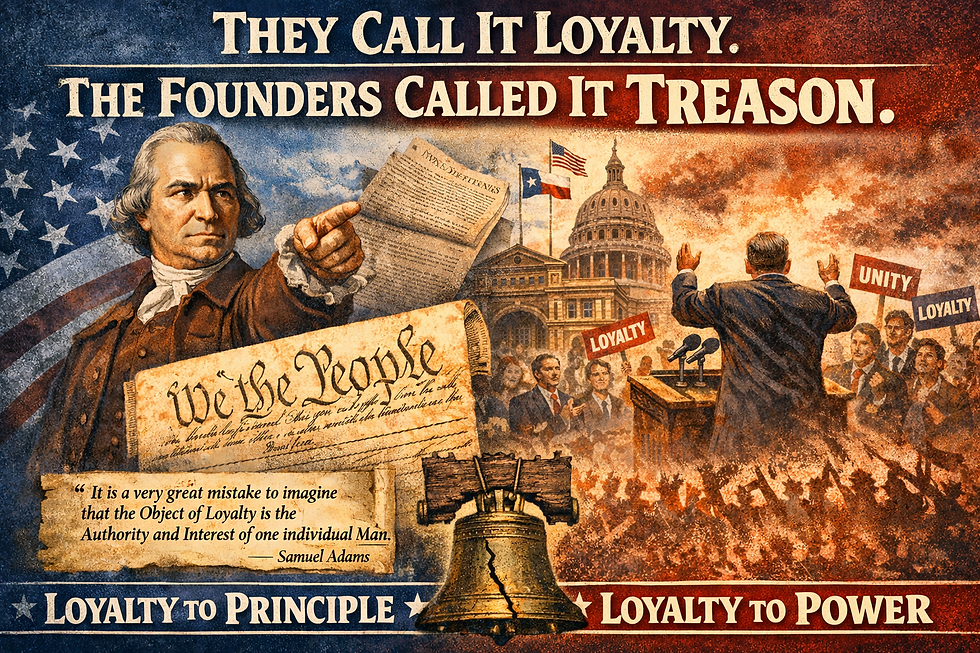
They Call It Loyalty. The Founders Called It Treason.
- Dewey R. Collier

- Feb 11
- 3 min read
Samuel Adams settled this argument before there was even a United States.
In 1748, he warned that powerful men would twist language — that they would redefine “loyalty” to mean obedience to a person, rather than fidelity to a constitution.
He wrote:
“It is a very great mistake to imagine that the Object of Loyalty is the Authority and Interest of one individual Man.”
That sentence should be engraved over every legislative chamber in Texas.
Because what we are seeing today — in Austin, in party politics, in local races — is not a fight between conservatives and liberals.
It is a fight between loyalty to principle and loyalty to personalities.
What the Founders Meant by Loyalty
Adams defined true loyalty as:
“a firm and inviolable attachment to a legal Constitution.”
Not attachment to:
An incumbent.
An endorsement.
A governor.
A party brand.
A PAC president.
A political benefactor.
Attachment to the Constitution.
And what does that require?
Adams said it requires:
Knowing the Constitution.
Defending it.
Being jealous for our immunities.
Supporting only laws that preserve it.
If a government expands beyond its delegated authority, Adams said loyalty cannot exist there — because arbitrary power destroys liberty.
Thomas Gordon, whose Cato’s Letters deeply influenced the Founders, was even more blunt:
“Every lawless prince is a rebel.”
And he didn’t stop there.
“He who commands, and he who obeys, are outlaws and disloyalists.”
Read that carefully:
If power violates law — those who defend it in the name of “unity” or “loyalty” are participating in disloyalty.
Sedition Isn’t Resistance to Tyranny.
It’s Support for It.
Adams defined sedition as:
“all Tendencies, Machinations, and Attempts to overset a legal Constitution.”
Not criticism. Not dissent. Not challenging incumbents.
Sedition is curtailing liberty.
Sedition is introducing arbitrary measures.
Sedition is winking at constitutional violations because “our guy” benefits.
The Founders were clear: the real rebels are those who normalize illegal power.
And here is the tactic Adams warned us about:
Flip the script.
Call dissenters “divisive.” Call constitutionalists “disloyal.” Call challengers “rebels.”
Call submission “unity.”
Sound familiar?
How This Applies to HD-5
In this district, voters are told that loyalty means falling in line.
We’re told:
Don’t question incumbents.
Don’t question spending.
Don’t question property tax schemes.
Don’t question corporate abatements.
Don’t question endorsements.
Don’t question process manipulation.
But Samuel Adams would have asked a different question:
Are these actions faithful to the Constitution — or faithful to political survival?
Let’s take just one issue: property taxes.
Texas collected roughly $79.5 billion in property taxes in 2022, with about 55% coming from school taxes (M&O and I&S combined).
We’re told eliminating homestead property taxes is “impossible.”
We’re told to be loyal to incremental compression.
We’re told to trust the process.
But loyalty, according to Adams, is not trusting the process.
It is demanding that government operate within its constitutional limits and in the interest of the People.
When public money is treated like a political tool; when abatements favor corporations while homesteaders carry the load; when branding replaces measurable relief:
That is not loyalty to Texas families.
That is loyalty to power.
Branding vs. Governing
This campaign has said it plainly:
Conservatism without results is just branding.
Samuel Adams would agree.
True loyalty isn’t attending fish fries.
It isn’t repeating talking points.
It isn’t defending every act of an officeholder.
True loyalty is this:
Freeze spending.
Eliminate homestead property taxes.
Refuse unconstitutional expansion of power.
End corporate favoritism.
Demand transparency.
Restore constitutional restraint.
Not because it’s popular.
Because it’s right.
The Founders’ Warning
Adams warned that people who promote illegal power often accuse the defenders of liberty of being the problem.
Thomas Gordon described it perfectly:
Those who defend law and virtue are labeled rebels — while the instruments of illegal power are called loyalists.
We are living that inversion today.
The question for HD-5 voters is simple:
Are we loyal to personalities?
Or are we loyal to the Constitution?
Because the two are not the same.
And they never have been.
Our Position
This campaign stands where Samuel Adams stood:
Loyalty belongs to liberty.
Loyalty belongs to law.
Loyalty belongs to the Constitution.
Loyalty belongs to the People.
Anything else — no matter how it’s marketed — is something else entirely.
As the Founders reminded us:
Concordia res parvae crescunt. Small things grow great by concord.
But only when that concord is built on principle.


Comments